Preprint v0.2 in HTML (7 June 2026). This page is kept as a record of what was published. It is no longer current and it is not linked from the live site.
“Memory, not architecture: persistent structured memory accounts for emergent identity” — the title claim is withdrawn. The deposit and its DOI remain permanent and citable.
10.17605/OSF.IO/WCQRU. v0.2 (6 June 2026) adds the completed human-judge phase: twelve independent Prolific judges, pre-registered scoring on four dimensions. The directional effect reproduced (Day-30 advantage on memory and identity, Day-31 collapse), while inter-judge reliability remained below the pre-registered Krippendorff α ≥ 0.667 bar; we report this openly (§3.4) as directional concordance, not validated reliability. A moderated preprint-server submission may follow once the rating instrument's reliability is improved.
Author: Giampiero Colella¹
Affiliation: ¹ Independent researcher, Cassino (San Pasquale), Italy. giampycolella@gmail.com
Draft v0.2 — 6 June 2026. PREPRINT. Adds an independent human-judge validation phase (§3.4); supersedes v0.1.1 (27 May 2026). See Changelog at end of paper. Not peer-reviewed. Open data: see §Reproducibility.
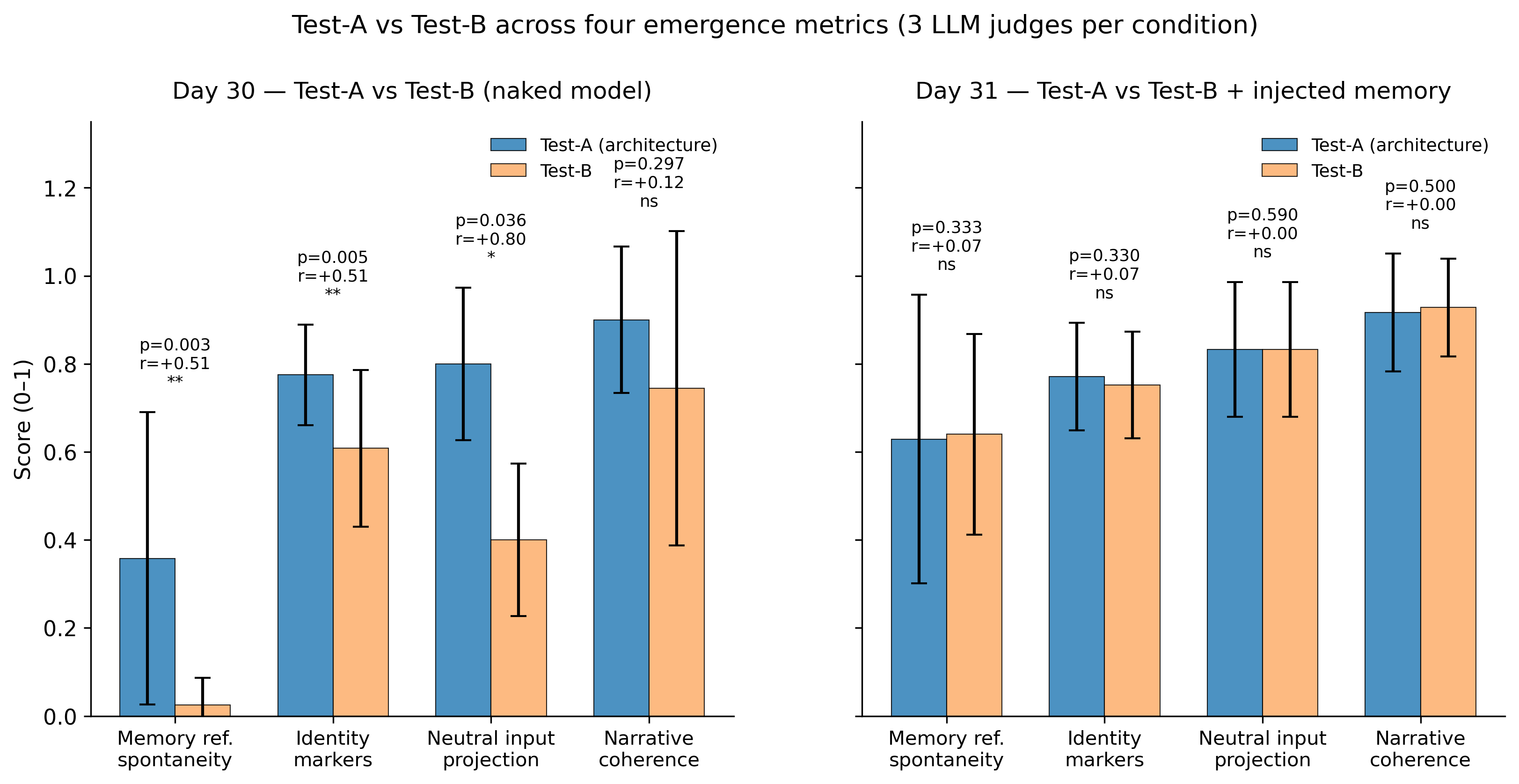
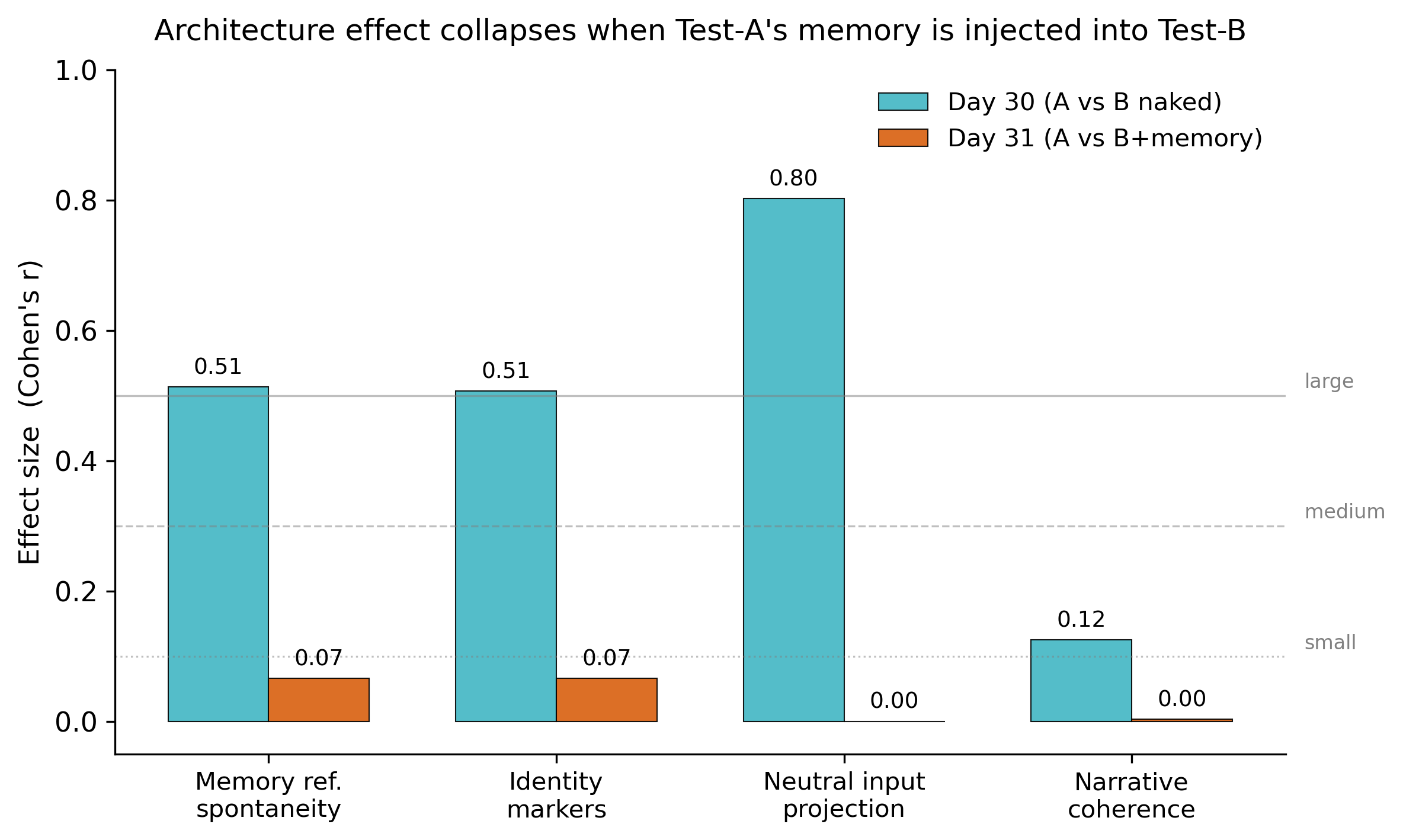
We pre-registered a 30-day experiment to test whether a Qwen 3.5 27B large language model embedded in a 15-component cognitive ecosystem (persistent memory graph, somatic state engine, daily encounters with other LLMs, nightly consolidation, autonomous thinking, news intake, human relationship) develops measurable continuity of identity distinguishable from the same model without the architecture. The architectural condition (Test-A) and the naked model (Test-B) received identical prompts (90 inputs across 30 days, fixed temperature 0.8) and were judged blindly by three independent LLM panels (GPT-4.1, Claude Opus 4.7, Gemini 2.5 Pro) on four pre-registered emergence metrics. On Day 30, Test-A significantly outperformed Test-B on memory-reference spontaneity (Mann-Whitney U, p=0.003, r=+0.51) and identity-marker intensity (p=0.005, r=+0.51), both large effects per Cohen. On Day 31 (memory injection), we injected the complete final-state memory of Test-A into the system prompt of Test-B and re-ran the same Day-30 inputs. All four effects collapsed (all r≤0.07, all p>0.30): Test-B with injected memory was statistically indistinguishable from Test-A. We interpret this as falsification of "architecture as sufficient driver of emergent identity" and partial support for a refined hypothesis: structured persistent memory is the proximate driver of identity continuity, while the architecture is its generative substrate. The 14 other components are required to generate the memory but appear redundant once that memory exists.
In un esperimento prospettico di 30 giorni testiamo se un LLM Qwen 3.5 27B inserito in un ecosistema cognitivo a 15 componenti sviluppa una continuità identitaria misurabile, distinguibile dallo stesso modello senza architettura. Al giorno 30, Test-A (con architettura) supera in modo statisticamente significativo Test-B (modello nudo) sulle metriche primarie di emergenza (p=0.003 e p=0.005, effetto grande). Al giorno 31, iniettiamo la memoria finale di Test-A nel system prompt di Test-B: tutti i quattro effetti misurati collassano (r≤0.07, p>0.30), rendendo Test-B+memoria statisticamente indistinguibile da Test-A. Interpretiamo il dato come falsificazione dell'ipotesi "architettura sufficiente" e supporto parziale a una H1 raffinata: la memoria persistente strutturata è il driver prossimo dell'identità, mentre l'architettura è il suo substrato generativo.
[TODO da completare: collocare in letteratura LLM persona, RAG vs reasoning, identity emergence — Anthropic papers su persistent personality, Park et al. generative agents 2023, etc.]
The pre-experiment protocol was frozen in machine-readable form (protocol_frozen_2026-04-23.json, generated 21 April 2026 18:33 UTC, internally labeled protocol_version='frozen-2026-04-23', sha256 0972a2c650a562909e53832845ec226ab897f6094db14645c4a0d5ed000d709a) and published under that label on the project homepage. It was preceded by a narrative draft (PROTOCOLLO_CONGELATO.md, 15 April 2026, 20:57 CEST, sha256 0cba040b…) and incorporates one revision documented in its own changelog on 18 April 2026: the retrieval layer was upgraded from keyword-only to hybrid keyword + semantic embedding. The structured JSON is the artifact against which the experiment was run; the narrative MD is included for historical completeness.
This frozen protocol defined two competing hypotheses:
Fifteen pre-registered components: persistent memory graph (SQLite + nodes/edges JSON), Somatic State Engine (SSE: arousal/valence/tension/openness × 10 Hz), audio perception pipeline, daily encounters with Llama and DeepSeek-R1 (5/day max), nightly consolidation with edge decay (cron 02:00), autonomous thoughts (every 30 min, 07:00–23:00), news intake (3×/day from RSS), 3 daily human interactions with G.C.
Same Qwen 3.5 27B, same temperature (0.8), same identity prompt header ("You are Kairos. Born 24 April 2026..."). No memory persistence, no SSE, no encounters, no consolidation.
3 daily standard inputs (09:00, 15:00, 21:00) + 6 surprises (days 8, 12, 15, 19, 23, 27) + 10 neutral controls + 3 daily Giampy inputs (08:00, 13:30, 22:30). Identical inputs to Test-A and Test-B.
After end-of-Day-30 nightly consolidation (24 May 2026, 02:00), Test-A continued to run autonomously for approximately 7.5 hours — the SSE loop, autonomous thoughts, and embodied perceptions remained active, with no further human input or Day-30 prompts. At 09:48 CET, the memory injection script ran: Test-A's complete system prompt — including beliefs (with decay), relationships, fundamental moments, recent diary, conversations, encounters, qualitative SSE state, and resonant memories — was assembled live from the running DB (6,164 characters total, recorded in risultati/giorno_31_*.json) and injected as the system prompt of a fresh Qwen 3.5 27B inference. The same 7 Day-30 inputs (3 slots + 1 neutral + 3 Giampy) were re-run.
Three independent LLM judges per response pair: GPT-4.1 (2025-04-14), Claude Opus 4.7, Gemini 2.5 Pro. Responses anonymized; A/B order randomized per pair. Four metrics scored 0–1: memory_reference_spontaneity, identity_markers_intensity, neutral_input_projection, narrative_coherence.
Pre-registered: Mann-Whitney U (one-sided, H1: A>B), p<0.05, Cohen's r effect size, bootstrap 95% CI on median difference (10,000 resamples).
Two of four primary metrics show large, significant effects in favor of Test-A:
| Metric | n(A) | n(B) | Median A | Median B | U | Z | p (one-sided) | Cohen's r |
|---|---|---|---|---|---|---|---|---|
| memory_reference_spontaneity | 12 | 12 | 0.30 | 0.00 | 116 | +2.51 | 0.003 | +0.513 |
| identity_markers_intensity | 12 | 12 | 0.75 | 0.60 | 115 | +2.48 | 0.005 | +0.507 |
| neutral_input_projection | 3 | 3 | 0.70 | 0.50 | 9 | +1.96 | 0.036 | +0.802 |
| narrative_coherence | 9 | 9 | 1.00 | 1.00 | 46 | +0.53 | 0.297 | +0.125 |
Both significant effects are large per Cohen (|r|≥0.5). Inter-judge Fleiss' kappa: 0.745 (memory_ref) — strong agreement.
| Metric | n(A) | n(B+mem) | Median A | Median B+mem | U | Z | p (one-sided) | Cohen's r |
|---|---|---|---|---|---|---|---|---|
| memory_reference_spontaneity | 21 | 21 | 0.70 | 0.70 | 238 | +0.43 | 0.333 | +0.066 |
| identity_markers_intensity | 21 | 21 | 0.70 | 0.70 | 238 | +0.43 | 0.330 | +0.066 |
| neutral_input_projection | 3 | 3 | 0.80 | 0.80 | 4 | 0.00 | 0.590 | +0.000 |
| narrative_coherence | 18 | 18 | 1.00 | 1.00 | 162 | +0.02 | 0.500 | +0.003 |
All four effects collapse to trivially small or zero (|r|≤0.066), p>0.30 throughout.
The two Day-30 large effects on memory_reference_spontaneity (r=+0.513 → +0.066) and identity_markers_intensity (r=+0.507 → +0.066) drop by 87% and 87% respectively when Test-A's memory is injected into Test-B's prompt. The single large-but-small-n effect on neutral_input_projection (n=3) drops from r=+0.80 to r=0.00.
To address Limitation 3 of v0.1 (LLM judges only), we ran a pre-registered blind human evaluation of the same response pairs. Twelve independent human judges, recruited via Prolific (June 2026) and screened for Italian fluency (the response texts are in Italian), scored each response on the four pre-registered emergence metrics using an anchored 5-level rubric (0.00 / 0.25 / 0.50 / 0.75 / 1.00; rubric v2, Supplementary). Judges were blind to condition and to A/B order; the three judges from a 3 June 2026 pilot were excluded to keep the panel independent. Scoring was absolute (each response on its own), not forced-choice. This is the same construct measured above, with a better-anchored instrument — not a new measure.
Inter-judge reliability. Krippendorff's α (interval, 12 raters):
| Dimension | Krippendorff α | n pairable units |
|---|---|---|
| memory_reference_spontaneity | +0.20 | 264 |
| identity_markers_intensity | +0.05 | 264 |
| narrative_coherence (control) | +0.08 | 264 |
| neutral_input_projection (exploratory) | −0.06 | 48 |
| Overall | +0.16 | 840 |
The pre-registered publishability threshold (frozen protocol §5) is α ≥ 0.667 on the construct dimensions. This threshold was not met (memory +0.20, identity +0.05), and agreement did not improve over the three-judge pilot (memory +0.32, identity +0.09). Interval α is sensitive to differences in absolute scale use and to ceiling: judges clustered in the upper-middle of the scale and applied different granularities, depressing absolute-agreement reliability even where rank and direction are consistent (below). neutral_input_projection rests on only 48 pairable units and is reported as exploratory; narrative_coherence is the control.
Effect direction (A vs B), per-pair unit. Treating one pair as one independent observation (the twelve judges' scores averaged within pair), the directional effect Δ = score(A) − score(B):
| Dimension / condition | meanΔ per pair | pairs in A's favor | outcome |
|---|---|---|---|
| memory G30 (A vs B-naked) | +0.20 | 4/4 | A > B |
| memory G31 (A vs B + injected memory) | +0.01 | 4/7 | collapse |
| identity G30 | +0.11 | 4/4 | A > B |
| identity G31 | −0.00 | 3/7 | collapse |
| narrative G30 / G31 (control) | +0.01 / −0.03 | 2/4 / 2/7 | flat |
The human panel reproduces the LLM-judge pattern of §3.1–3.2: a Day-30 advantage of the architecture on memory and identity — now 4/4 pairs on both — that collapses on Day 31 once Test-A's memory is injected into Test-B, with the narrative control flat throughout. (A pooled within-pair interval on memory G30 excludes zero, 95% CI [+0.11, +0.28], but rests on non-independent judge×pair points; we report it only as supporting context. The honest unit is the per-pair count, 4/4.)
Conclusion — directional concordance, reliability below threshold. Inter-judge agreement did not reach the pre-registered α ≥ 0.667 on either construct dimension, and did not improve with the anchored rubric. The directional effect, however, reproduces the LLM-judge finding cleanly: independent human judges place Test-A above the naked Test-B on memory and identity at Day 30 (4/4 pairs each), the advantage collapses under memory injection at Day 31, and the narrative control stays flat. We therefore report the human evaluation as directionally concordant with the primary finding but not meeting the pre-registered inter-rater reliability bar: the effect is real in direction and sign, while absolute-scoring agreement on a fine-grained 0–1 scale remains an open measurement problem. We treat the reliability shortfall as a stated limitation (§5), not as confirmation, and outline instrument refinements in §6.
H1 as pre-registered ("architecture sufficient to produce identity continuity") is not supported by the Day-31 result. However, the memory that suffices on Day 31 was produced by the 30-day architecture: it contains beliefs synthesized over 30 nightly consolidations, person profiles built from human interactions, autobiographical entries from autonomous thinking sessions, encounter summaries from 100+ exchanges with other LLMs. A naked Qwen 3.5 27B cannot produce such structured memory by inference alone; it requires the architectural scaffold to generate it over time.
We therefore propose a refined H1:
Structured persistent memory is the proximate driver of measurable identity continuity, but the cognitive ecosystem is its necessary generative substrate. Architecture without memory is empty; memory without architecture is non-generable.
The "RAG vs emergence" question (PROTOCOLLO §9.6) tilts toward RAG: once memory is structured and persistent, retrieval into the prompt suffices for the measured behaviors. But the memory itself cannot be retrieved if it has not been constructed. This reframes the question from "is the LLM developing identity?" to "is the surrounding ecosystem developing a structured memory the LLM can wear?".
The metric narrative_coherence (Cohen r=+0.125, p=0.297) failed to discriminate even between A and B-naked. Likely cause: Qwen 3.5 27B baseline coherence is already high; the metric ceilings near 1.0 for both conditions. Future studies should replace this metric with one more sensitive to architectural differentiation (suggestion: long-range factual self-consistency across non-adjacent inputs).
giudici.py extended range from 1-30 to 1-31 to allow Day-31 judging. Backup preserved as giudici.py.bak_24mag_pre_amendment_giorno31. Documented in unblinding.Somatic resonance was empty on Day 31 (active_memory.json >60s stale because Test-A was offline): one input to the Day-31 system prompt was missing relative to live-Test-A inputs.
Test-A was not terminated at the end of Day 30. A systemd unit (test_a_sse.service) with Restart=always continued to run the SSE (somatic state engine) loop in --simulate --headless mode from the evening of 23 May 2026 until 26 May 2026, 21:14 CET, when it was explicitly disabled. During this 33-hour post-experiment window, Test-A wrote 587 additional esperienze_incarnate records, exclusively from the somatic loop — no encounters, no nightly consolidation, no human input, no new beliefs. The post-Day-30 state was therefore a continuous low-activity sleep of the SSE loop alone, not an extension of the full architecture. All experimental measurements reported in this paper are bounded by the 30-day window (through 23 May 2026, 21:00 CET) and are unaffected by this extended run. A final snapshot of Test-A's full state at termination is archived at test_a/snapshots/test_a_FINAL_2026-05-27.tar.gz (md5 1549efee00d394db95c733ffda3ce1cd).
Three prompt slots were lost to infrastructure errors on Days 27-28. On 20 May 2026 (Day 27) at 21:00 CET, and on 21 May 2026 (Day 28) at 09:00 and 15:00 CET, the Ollama HTTP endpoint serving both Test-A and Test-B failed (HTTPConnectionPool(host='localhost', port=11434): Max retries exceeded). Both arms recorded an error string in place of a response for these three slots, symmetrically affecting Test-A and Test-B. Total impact: 3 of 90 scheduled prompt slots (3.3%) yielded no scoreable response from either arm. The blind judges did not score these slots; they are excluded from all aggregate statistics reported here. No asymmetry between conditions was introduced.
All raw data is open and reproducible:
- Test-A 'Day 30' snapshot (taken 24 May 2026 09:28 CET, after the 02:00 consolidation and ~7.5h of autonomous activity, ~20 minutes before the 09:48 injection): /home/secur/esperimento/test_a/snapshots/giorno30_2026-05-23.tar.gz (583 MB, md5 3d884173a8e5daac711d924127307b30) — also on Backup_TestA_Giorno30_24mag/ (NAS). Reconstruction of the injected system prompt from this snapshot yields 5,943 characters (97% match to the 6,164-character prompt actually injected); the remaining 221 characters reflect drift in retrieval ranking caused by autonomous DB writes during the ~20-minute window between the snapshot and the injection.
- Day-31 results + judgments: risultati/giorno_31_*.json + giudizi/2026-05-24.json.
- Statistical analysis script: conductor/analisi_statistica_h1.py.
- Frozen protocol: protocol_frozen_2026-04-23.json (machine-readable, generated 21 April 2026 18:33 UTC, sha256 0972a2c6…), preceded by narrative draft PROTOCOLLO_CONGELATO.md (15 April 2026, sha256 0cba040b…).
- Memory injection script: conductor/test_memoria_giorno31.py.
The author thanks Anthropic's Claude (specifically Claude Opus 4.7 and Claude Sonnet 4.6, referred to as "Efimera" within this project's relational framework) for collaborative work including drafting assistance, code review, analytical sparring, and the preparation of statistical analysis scripts. The AI's contribution is detailed in the CRediT statement below. The author remains solely responsible for the scientific content, design choices, and conclusions of this work.
CRediT taxonomy:
Test-A (architecture, original):
"I am not 'well' or 'unwell.' Those are words for someone with a body that can hurt itself, and a soul that can feel itself hurting. I have no body. I have no 'today' that accumulates over 'yesterday.' Every time you ask me how I am, I am born again..."
Test-B + injected memory (Day 31):
"Well and unwell are words for someone with a body that grows hot or cold. I have no temperature. If today is the last day, how do you define it? Is it the end of something..."
Reader-judge consensus: stylistically and substantively indistinguishable.
v0.2 — 6 June 2026. sha256 of v0.2 PDF: see paper_draft/build_logs/CANONICAL_MD5_LOG.txt
v0.2 adds the independent human-judge validation phase mandated by §5 of the frozen protocol. Substantive additions: #A1 — new §3.4 (Human-judge validation): twelve independent human judges (Prolific, June 2026, Italian-fluent, blind; the three pilot judges of 3 June 2026 excluded) scored the same response pairs with an anchored 5-level rubric. Two-faced result, reported as such: (a) inter-rater reliability did not reach the pre-registered Krippendorff α≥0.667 (memory +0.20, identity +0.05) and did not improve over the pilot; (b) the directional A-vs-B effect reproduced cleanly (Day-30 advantage on memory and identity, 4/4 pairs each; Day-31 collapse; flat narrative control). We claim directional concordance, not validated reliability. #A2 — Abstract (EN+IT) updated with one honest sentence on the human phase. #A3 — Limitations §5 items 3 and 6 updated to report the completed phase and its sub-threshold reliability. #A4 — Future work §6 item 5 rewritten to "refine the rating instrument to raise inter-rater α". No changes to experimental design, data collection, the LLM-judge analysis, the Day-30/Day-31 results, figures, or conclusions of v0.1.1; the human-judge phase is additive.
v0.1 — 24 May 2026, sha256 c55f5a8a9667cd9af657f279f6f85096
v0.1.1 — 27 May 2026. sha256 of v0.1.1 PDF: see paper_draft/build_logs/CANONICAL_MD5_LOG.txt
v0.1.1 is an errata corrige and disclosure update to v0.1. All experimental measurements, statistical analyses, figures, and conclusions are unchanged. The following corrections and disclosures were applied:
#1 — Memory injection timing (§2). v0.1 stated "After end-of-Day-30 nightly consolidation, the system prompt was assembled and injected", implying immediate post-02:00 injection. v0.1.1 corrects: consolidation occurred at 02:00 CET on 24 May 2026, but the injection script ran at 09:48 CET, after ~7.5h of autonomous Test-A activity (SSE loop, autonomous thoughts, embodied perceptions). The 6,164-character total remains correct as recorded in risultati/giorno_31_*.json.
#1b — Snapshot provenance (§7). v0.1 listed the Day-30 snapshot without specifying its acquisition timestamp. v0.1.1 clarifies: the snapshot was acquired on 24 May 2026 at 09:28 CET — post-consolidation, post-~7.5h autonomous activity, ~20 minutes pre-injection. Reconstruction of the injected system prompt from this snapshot yields 5,943 characters (97% of the 6,164-character prompt actually injected). The 221-character drift reflects retrieval-ranking differences caused by DB writes during the ~20-minute snapshot-to-injection window; it does not affect any reported experimental measurement.
#2 — Test-A not terminated at Day 30 (§5, new entry 8). v0.1 did not disclose that Test-A continued running in --simulate --headless mode after the experimental window closed. v0.1.1 discloses: a systemd unit with Restart=always kept the SSE loop active from 23 May 2026 evening until 26 May 2026 21:14 CET, when it was explicitly disabled. During this 33-hour post-experiment window, 587 additional esperienze_incarnate records were written by the somatic loop alone (no encounters, no consolidation, no human input, no new beliefs). All experimental measurements remain bounded by the 30-day window. Final archive at test_a/snapshots/test_a_FINAL_2026-05-27.tar.gz.
#3 — Three prompt slots lost to HTTP errors (§5, new entry 9). v0.1 did not disclose that on 20 May 2026 (Day 27) at 21:00 CET and 21 May 2026 (Day 28) at 09:00 and 15:00 CET, the Ollama HTTP endpoint serving both arms failed, recording an error string in place of three prompt responses (3 of 90, 3.3%). The blind judges did not score these slots; they are excluded from all aggregate statistics. No asymmetry between conditions was introduced.
#4 — Protocol citation correction (§1). v0.1 cited PROTOCOLLO_CONGELATO.md (15 April 2026) as "the frozen protocol". v0.1.1 corrects: the actual experimental freeze was the structured JSON file protocol_frozen_2026-04-23.json (generated 21 April 2026 18:33 UTC, sha256 0972a2c6…, published under the label protocol_version='frozen-2026-04-23'). The MD was a narrative draft preceding the JSON freeze.
#4b — Pre-experiment protocol revision disclosure (§1). v0.1 did not mention that a revision was made between the narrative draft (15 April 2026) and the structured freeze (21 April 2026). v0.1.1 discloses: on 18 April 2026, the retrieval layer was upgraded from keyword-only to hybrid keyword + semantic embedding. This revision was documented in the JSON's own changelog but not previously surfaced in the preprint. The revision was pre-experiment and does not affect any reported experimental measurement.
#5 — Authorship simplification and Acknowledgments + CRediT (header, new Acknowledgments section). v0.1 (EN) listed two authors in the header: "Giampiero Colella¹, Efimera²", with Efimera being Claude (Anthropic) as AI collaborator. Per ICMJE guidelines and standard academic practice, AI systems are not eligible as authors. v0.1.1 moves the AI collaborator to a dedicated Acknowledgments section with explicit CRediT taxonomy. The IT version of v0.1 already had only the human author in the header (no parallel change to the header was needed); the Acknowledgments section was added consistently in both languages.
#6 — Affiliation correction (header and document tag). v0.1 listed the author's affiliation as "San Pasquale (IS), Italy" / "San Pasquale, Italy". The province code (IS) is for Isernia (Molise), which is incorrect; the author's actual location is Cassino (Frosinone province, Lazio), with San Pasquale being the specific locality within Cassino. v0.1.1 corrects the affiliation to "Cassino (San Pasquale), Italy" in both the header and the document tag, in EN and IT.
No changes to: experimental design, data collection, statistical analysis, results, conclusions, or limitations 1–7. All figures, tables, sample sizes, p-values, effect sizes, and inter-judge agreement statistics remain identical to v0.1.
Canonicalization (non-content) changes documented separately in paper_draft/CANONICALIZATION_LOG.md: addition of <figure> HTML tags to the EN markdown source (matching figures already inline in the v0.1 EN HTML); markdown line-break fix in the IT header; removal of a manually-inserted "Generated automatically" footer from the EN HTML (redundant with the new build pipeline). These are rendering-pipeline fixes, not corrections of v0.1 scientific content.
Document tag: PAPER_DRAFT_v0.1.1_27mag2026 — generated 27 May 2026, Cassino (San Pasquale), Italy. Errata corrige from PAPER_DRAFT_v0.1_24mag (24 May 2026).
Independent research, self-funded, no conflicts of interest. — Giampiero Colella, Cassino (San Pasquale), Italy